Cellular Health
The senescence-associated secretory phenotype and how it spreads to neighbours
A cell that stops dividing does not fall silent but starts secreting, and what it secretes can push nearby healthy cells into the same state.
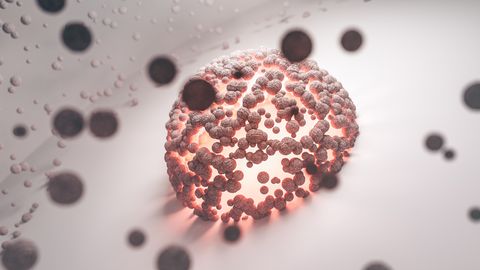
An active program rather than a failure
A senescent cell has permanently exited the division cycle while remaining metabolically active, which distinguishes it from a dying or dormant cell. The state is triggered by several different inputs, including damage to DNA, shortened chromosome ends and activation of certain growth-promoting genes. In each case the program acts as a brake, preventing a cell carrying a dangerous change from passing that change to descendants.
This makes senescence a tumour-suppressing mechanism in origin, which is why an organism that could not enter the state would be worse off. The state also participates in wound repair and in normal tissue development, appearing transiently and then resolving through immune clearance.
What the secretory profile contains
Senescent cells release a mixture that includes inflammatory signalling proteins, enzymes that remodel the surrounding structural matrix, and growth factors. The composition of that mixture varies with the trigger and with the cell type, so there is no single profile that defines the state. Some components attract immune cells, which is presumably how transient senescence is normally resolved during repair.
Others alter the mechanical and chemical environment of neighbouring tissue in ways that persist while the secreting cell remains present. The dual character of the profile, useful in the short term and disruptive when sustained, is the central feature of the phenomenon.
How the state propagates
Components of the secreted mixture can induce the same state in nearby cells that carry no damage of their own, which has been shown in culture. The effect appears to involve both diffusible signals and small membrane-bound packages released by the secreting cell. Propagation matters because it means the burden in a tissue can grow faster than the rate at which new damage occurs.
It also complicates any attempt to relate a measured burden to the original triggering exposure, since much of it may be secondary. How much propagation contributes in intact human tissue, rather than in culture, is not currently quantified with any confidence.
The measurement problem
There is no single marker that identifies a senescent cell reliably, and every commonly used marker also appears in other conditions. Investigators therefore use combinations, requiring several features together before classifying a cell, which improves specificity at the cost of sensitivity. Different laboratories use different combinations, so reported burdens in comparable tissues are not directly comparable between groups.
Circulating markers proposed as proxies for tissue burden are influenced by many processes other than senescence, which limits their interpretation. This is why claims about a person's senescent cell burden, based on a blood test, run well ahead of what the field can measure.
What the immune contribution implies
Transient senescence is normally resolved because immune cells recognise and remove the affected cells within a reasonable period. Immune function itself changes with age, so a decline in clearance capacity would allow accumulation even without any increase in production. This raises the possibility that accumulation reflects a clearance problem as much as a generation problem, and both hypotheses have support.
The distinction matters because interventions aimed at killing these cells and interventions aimed at restoring clearance are entirely different strategies. Both approaches are under investigation, neither is established in people, and anything offered commercially on this basis is running well ahead of the evidence.
- Senescence is an active program, not a passive shutdown
- The secreted profile serves useful functions before it becomes harmful
- Detection in tissue relies on imperfect combined markers
Also by Priya Patel
- Adenosine and sleep pressure: what the two-process model actually claimsSleep Biohacking
- Grip strength and gait speed: why the crudest functional measures carry so much informationBiohacking
- Median and maximum lifespan respond to different things, and the difference is informativeLongevity Science
- Surrogate endpoints in longevity trials, and why a moved marker is not a longer lifeTop