Gut Microbiome
The colonic mucus layer behaves like a negotiated border rather than a wall
The gel lining the large intestine both excludes bacteria and feeds them, and that apparent contradiction is the mechanism keeping a dense microbial population at a safe distance.
Two layers with entirely different jobs
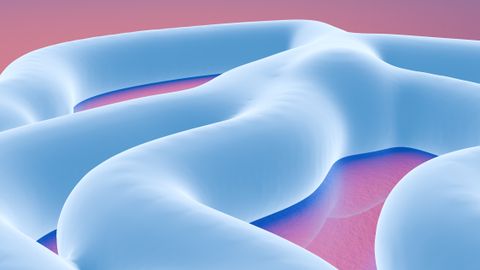
The colon is lined by a mucus system built from large gel-forming glycoproteins that specialised cells in the epithelium secrete continuously. In the large intestine this system organises itself into two layers with markedly different properties despite being made from the same core protein. The inner layer is dense, firmly attached to the epithelial surface and, in a healthy state, largely free of bacteria.
The outer layer is looser, expanded and heavily colonised, functioning as habitat rather than as any kind of exclusion barrier. That arrangement keeps a dense microbial population within a very short distance of host tissue while maintaining physical separation from the cells themselves.
Why the border is negotiated rather than sealed
The sugar chains decorating mucus proteins are a usable food source, and several resident bacterial species specialise in cleaving and consuming them. This means the host is deliberately feeding part of its microbial population with the same material that holds that population at a distance. The arrangement stays stable because secretion is continuous and the inner layer is renewed from beneath faster than it is degraded from above.
When fermentable fibre is scarce, some species shift toward mucus sugars as a substitute substrate, which raises degradation pressure on the layer. Work in animals indicates this thins the barrier, though how directly that observation transfers to ordinary human diets is not fully established.
Why published thickness figures vary
Mucus is mostly water and collapses when tissue is fixed by conventional methods, so early anatomical descriptions substantially underestimated its extent. Preserving the layer requires fixation that avoids aqueous exposure, and results differ depending on which technique a particular laboratory uses. Measurement in living tissue is harder still, and most detailed structural work has been carried out in rodents rather than in people.
Human sampling generally comes from biopsies or surgical specimens, where handling and the reason for the procedure both influence what is seen. This is a field where the measurement method accounts for a substantial share of the disagreement between published descriptions.
What the layer does immunologically
Beyond physical separation, mucus carries antimicrobial peptides and secreted antibodies that shape which organisms are able to approach the surface. The epithelium samples what is present through specialised cells, and the signals it receives influence tolerance rather than only defence. A thinner or more permeable layer allows more microbial products to reach immune cells, which changes the local signalling environment considerably.
Whether that shift causes inflammatory disease or merely accompanies it remains one of the genuinely unresolved questions in the field. Association between barrier changes and inflammatory conditions is well documented, while the direction of causation frequently is not.
What follows from the mechanism, and what does not
The mechanism explains why fibre intake and microbial composition are discussed together rather than treated as two separate subjects. It does not support the idea that a particular product repairs a barrier, since barrier integrity is not something a consumer test can assess. Popular accounts of a leaky gut typically borrow the vocabulary of permeability research while skipping the part where permeability is actually quantified.
Intestinal permeability can be evaluated in research settings using specific probe molecules, and those methods carry their own limitations and are not routine. Persistent digestive symptoms have many possible causes and warrant assessment by a clinician rather than interpretation through a barrier model.
- The colon has two mucus layers with opposite properties
- Mucus glycans are a food source for resident species
- Barrier integrity is not something a consumer test measures
Also by Sarah Williams
- Sleep spindles and slow oscillations: what consolidation looks like electricallySleep Biohacking
- Food sensitivity panels: what IgG testing measures and why interpretation is contestedFunctional Medicine
- The blood-brain barrier is a selective transport system, not a wallBrain Optimization
- What a fasting insulin measurement adds that a glucose reading leaves outMetabolic Health